Why Vintage Digital Cameras and Y2K Digicams Are Back
Compact digital cameras from the late 1990s and 2000s were once the technology everybody wanted to replace. Smartphones became better, screens became larger and the little silver, black and brightly coloured cameras that had documented holidays, parties and everyday life gradually disappeared into drawers.
Now they are back.
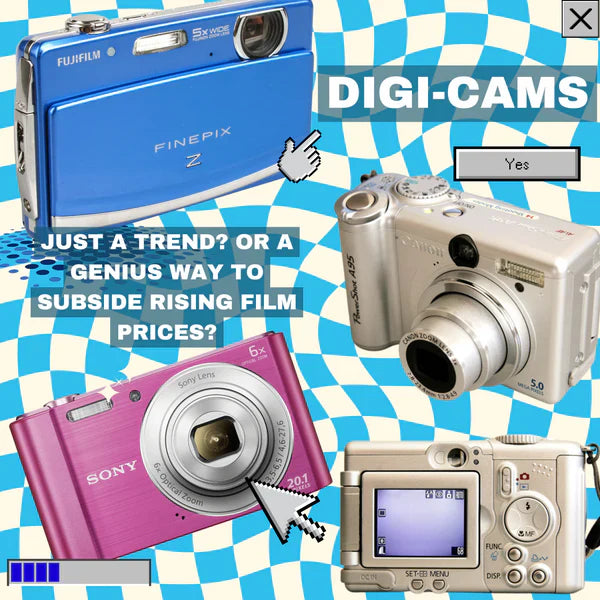
Canon PowerShots, Sony Cyber-shots, Nikon Coolpix cameras, Fujifilm FinePix models and countless other early digital compacts have found a new audience. Cameras that once looked outdated are being carried on nights out, taken on holiday and deliberately chosen instead of the technically superior camera built into a modern phone.
Part of that revival is nostalgia, but describing it as nostalgia alone misses the point. Older digicams offer something genuinely different: small bodies, simple controls, built-in flash, distinctive JPEG processing and photographs that often feel less polished than the increasingly sophisticated images produced by smartphones.
They also bring back the idea of carrying a camera whose main purpose is simply to take photographs. Browse Film Camera Store's Vintage Digital Compacts
Are Digicams Just Another Retro Trend?
When we first wrote about digicams in 2023, it was reasonable to ask whether they were simply another passing retro trend. Interest in 2000s technology, Y2K fashion and early social-media aesthetics was growing, and compact digital cameras were beginning to appear again in popular culture.
Several years later, that explanation looks incomplete.
The attraction has lasted because these cameras occupy an unusual position. They are old enough to produce photographs that can look noticeably different from modern smartphone images, but they still offer the convenience of digital photography. You can review a photograph immediately, take many images without buying another roll of film and transfer the files to a computer or phone afterwards.
At the same time, you still get the experience of using a separate physical camera. For some photographers that is just as important as the finished photograph.
The renewed interest in vintage digital cameras therefore sits comfortably alongside the continuing interest in film. You do not necessarily have to choose one or the other.
Why Do 2000s Digital Camera Photos Look Different From Smartphone Photos?
A modern smartphone is designed to make technically impressive photographs with very little effort. The phone may combine several exposures, brighten shadows, protect highlights, sharpen detail, reduce noise, adjust colour and apply other computational processing before you even see the finished image.
A compact digital camera from the 2000s works very differently.
The small sensor, lens, flash, automatic white balance, exposure system and JPEG processor all operate within the technological limitations of their period. Dynamic range may be more restricted, highlights can clip, shadows can become dark, colours can shift under artificial lighting and fine detail may look softer than we have become accustomed to.
Those characteristics were once viewed as weaknesses. Today, they are often part of the attraction.
It is important not to assume every old digital camera produces the same “retro” look, though. A Canon PowerShot can behave differently from a Sony Cyber-shot, while two cameras from the same manufacturer can also produce noticeably different results. The individual camera matters much more than simply buying something because it was made in the 2000s.
The Direct-Flash Look Is a Big Part of the Revival
One of the most recognisable characteristics of 2000s compact-camera photography is direct flash.
Most small digicams place a built-in flash close to the lens. Indoors or at night, that little flash fires almost directly towards the subject. Faces and clothing in the foreground can become brightly illuminated while the background quickly falls into darkness.
The result immediately recalls family parties, school trips, nights out and early social-media photographs from the period.
Modern phones can imitate aspects of that appearance, and editing apps can deliberately add retro effects, but an older compact camera creates the look as part of the way it naturally operates. You press the shutter and the camera makes its own decisions about exposure, flash, colour and white balance.
That slight unpredictability is one reason the experience can feel refreshing. The photograph does not always look technically perfect, and that can be precisely what gives it character.
A Separate Camera Changes the Way You Take Photographs
There is also a practical reason people enjoy using digicams again: they are cameras rather than phones.
Taking a photograph on a smartphone means using the same device that also contains your messages, social media, email, maps, music and almost everything else. A compact digital camera has one primary job.
You switch it on, wait for the lens to extend, frame the photograph and press the shutter.
That small separation can change the experience. You may take photographs without immediately checking notifications, editing them or deciding whether they should be uploaded somewhere.

Size matters too. Many 2000s digital compacts really are pocket cameras. A small camera that can disappear into a jacket pocket or bag is much more likely to come with you on a night out, weekend away or ordinary walk than a larger interchangeable-lens camera.
For many people, the best camera is still the one they actually carry.
Digicams Are Cheap to Shoot — Even If They Are Not Always Cheap to Buy
The original version of this article focused heavily on digicams as a cheaper alternative to rising film prices. There is still some truth behind that idea, but the market has changed.
A desirable vintage digital camera is not necessarily cheap anymore. Certain models have developed strong followings and prices can reflect that demand. It would therefore be misleading to suggest that every old compact camera is automatically a bargain.
Where digital still has an obvious financial advantage is after you have bought the camera.
A roll of film contains a fixed number of exposures and then needs processing and, in most cases, scanning. With a digital camera, the memory card can be reused repeatedly and there is no film or development cost attached to every press of the shutter.
That makes a digicam useful when you want to experiment, photograph casually or take large numbers of pictures without thinking about the cost of every frame.
The important distinction is that digital storage is not literally unlimited. Memory cards have finite capacity, older cameras may only support relatively small cards and the photographs still need to be backed up somewhere. But compared with a 24- or 36-exposure roll of 35mm film, the practical freedom to keep shooting is considerable.
CCD Sensors Are Part of the Story — Not the Whole Story
Spend any time around vintage digital cameras and you will encounter the term CCD digicam.
CCD sensors were widely used in compact digital cameras during the late 1990s and 2000s, and because so many photographs associated with that period were made using CCD-equipped cameras, the technology has become closely linked with the vintage digital aesthetic.
But a CCD sensor does not automatically create richer colours, film-like photographs or a particular retro appearance.
The finished image is influenced by the whole camera: its sensor, lens, built-in flash, exposure system, white balance, resolution and the manufacturer's JPEG processing.

This is why we would not choose an ageing camera purely because somebody has described it online as a desirable CCD model. Two CCD cameras can produce noticeably different photographs, and an older CMOS camera can still have a convincing early-digital character.
If the sensor question particularly interests you, our CCD Digicams Explained guide looks in much more detail at CCD versus CMOS and what really contributes to the retro digital-camera look.
Why Different Digicams Can Produce Very Different Results
The huge variety of cameras produced during the digital compact era is another part of the attraction.
Canon PowerShot, Sony Cyber-shot, Nikon Coolpix and Fujifilm FinePix were not single cameras. They were enormous product families produced across many years and aimed at very different buyers.
Some models were inexpensive family cameras with simple controls. Others offered optical zooms, manual exposure settings, better lenses or more sophisticated processing. Sony used several different Memory Stick standards, Fujifilm produced cameras using xD-Picture Card and developed its own Super CCD technology, while Canon and Nikon produced everything from straightforward point-and-shoot models to considerably more advanced compacts.
That means brand reputation alone tells you surprisingly little about how an individual camera will behave.

If you are comparing those major families, our Canon vs Sony vs Nikon vs Fujifilm vintage digicam guide explains the differences and practical considerations in considerably more detail.
Can a Digicam Replace a Film Camera?
It can replace film for some types of photography, but that does not mean it has to.
Film and early digital cameras offer different experiences. Film gives you the physical negative, the characteristics of a chosen film stock and the slower process of waiting to see the results. A digicam provides immediate review, reusable storage and the freedom to experiment without consuming another frame of film.
That makes the two surprisingly good companions.
You might carry a digicam for casual snapshots while saving your film camera for photographs you particularly want on film. You can experiment with composition, lighting or an unfamiliar location digitally without worrying about how many frames remain on the roll.
The digital photograph will not accurately predict exactly how a particular film stock, lens or exposure will render the final film image, so a digicam should not be treated as a perfect substitute for a professional film test. But as an everyday creative tool, it gives you the freedom to explore ideas quickly and cheaply.
That basic idea from the original 2023 article still makes sense today: a digicam can expand the way you shoot film rather than compete with it.
Original Vintage Digicam or a Modern Retro-Style Digital Camera?
There is now another choice that was much less common when the digicam revival began.
Alongside original compact cameras from the 1990s and 2000s, manufacturers and retailers now offer new digital compacts designed around the small size, simple operation and direct-flash experience associated with older digicams.
An original Canon PowerShot, Sony Cyber-shot, Nikon Coolpix, Fujifilm FinePix, Olympus, Kodak, Vivitar or Praktica gives you the genuine hardware, lens, sensor and JPEG processing of its period. If authenticity is what interests you, that matters.
The disadvantage is age. Batteries deteriorate, proprietary chargers disappear, LCD screens weaken, motorised lens mechanisms fail and older memory-card formats can become inconvenient.
A modern retro-style digital compact can avoid many of those problems by offering current batteries, charging and storage while retaining a simple pocket-camera experience. It will not produce exactly the same photographs as a twenty-year-old camera, but for somebody mainly interested in carrying a small separate digital camera, it can be a practical alternative.
What Should You Check Before Buying a Vintage Digicam?
A vintage digital camera is now an ageing electronic device, so condition matters more than fashion.
Before buying, check that it powers on reliably, that the lens extends and retracts properly where applicable, that autofocus works, the built-in flash fires and the LCD remains usable. Confirm what battery the camera needs and whether a compatible charger is included or still readily available.
Memory cards deserve particular attention. Depending on the model, an older digicam may use SD, CompactFlash, Sony Memory Stick, xD-Picture Card or another format. Older cameras can also have strict capacity limits, so a physically compatible card is not automatically guaranteed to work.
Battery corrosion, damaged card slots, sticky controls and unreliable lens mechanisms can turn an apparently inexpensive camera into a frustrating purchase.
Our Vintage Digital Camera Buying Checklist covers these checks in detail before you spend your money.
Which Digicam Should You Start With?
There is no single vintage digital camera that everybody should buy.
For a first digicam, practical usability usually matters more than collecting the most fashionable model. A dependable compact with a working flash, obtainable battery and charger, usable screen and memory card you can actually source is often a much better introduction than a highly sought-after camera in questionable condition.

If you mainly want a camera for parties and nights out, prioritise something genuinely small with a dependable flash. For holidays or everyday photography, battery life, optical zoom and convenient storage may matter more. If the finished look is your priority, find photographs taken with the exact camera you are considering rather than relying on a broad claim about the brand or sensor.
Our Best Vintage Digital Cameras for Beginners guide takes you through those choices in more detail.
Why the Digicam Revival Makes Sense
The return of the digicam makes more sense when you stop thinking of an old digital camera as a poor substitute for a modern one.
Technically, a current smartphone will outperform many 2000s compact cameras in almost every measurable way. That is not really the point.
People are returning to digicams because the limitations are part of the experience. The small sensor, built-in flash, modest resolution, sometimes unpredictable white balance and relatively simple JPEG processing can produce photographs that feel very different from today's highly polished phone images.
There is also pleasure in the physical camera itself: turning it on, hearing the lens extend, framing on a small LCD and discovering later what the camera actually captured.
For photographers who already shoot film, a digicam can provide a useful second camera for experimentation, nights out, travel and everyday photographs without consuming another roll. For somebody who has never shot film, it can offer an inexpensive-to-shoot way into the slower and more deliberate idea of carrying a dedicated camera.
So are digicams just a trend? Fashion undoubtedly helped bring them back into view, but their continued appeal comes from something more durable: they are small, fun, distinctive cameras that make photography feel different again.
Browse Film Camera Store's Digital Camera Collection or explore the dedicated Vintage Digital Compacts collection to see the cameras currently available.
Originally published 23 February 2023. Updated 21 October 2026 to reflect the renewed popularity of vintage digital cameras and current buying considerations.
(FCS-B-024)