
Beginner’s Guide to Metering Light and Getting Better Film Exposures
Getting the exposure right is one of the most important parts of shooting film. Unlike digital photography, you cannot immediately check the back of the camera and simply take the photograph again if it is too bright or too dark. A light meter helps you make that exposure decision before you press the shutter.
Many film cameras have a light meter built into the camera, while others rely on a separate handheld meter or the photographer's own judgement. Understanding what the meter is actually measuring — and knowing when not to trust it blindly — can make a significant difference to the consistency of your photographs.
In this guide, we explain how film camera light meters work, what TTL and centre-weighted metering mean, how ISO affects the reading, why old meters can sometimes be inaccurate and what you can do if the meter in a vintage camera no longer works.
What Is a Film Camera Light Meter?
A light meter measures the amount of light in a scene and helps the photographer choose an appropriate combination of aperture and shutter speed for the film being used. To calculate a useful exposure, the camera also needs to know the speed of the film, normally expressed as ISO or, on many older cameras, ASA.
For example, ISO 100 film requires more light than ISO 400 film. Once the correct film speed has been set, the meter can assess the available light and indicate whether the selected exposure is likely to result in too much light, too little light or an exposure close to what the meter considers correct.
A light meter cannot determine whether a photograph will be creatively successful. It provides exposure information; how that information is interpreted remains part of the photographer's decision-making.
How Does a Built-In Film Camera Light Meter Work?
Most built-in film camera meters measure light reflected from the subject and entering the camera. Depending on the model, that information might be shown through a moving needle, LEDs, arrows, exposure symbols or an indicated shutter speed inside the viewfinder.
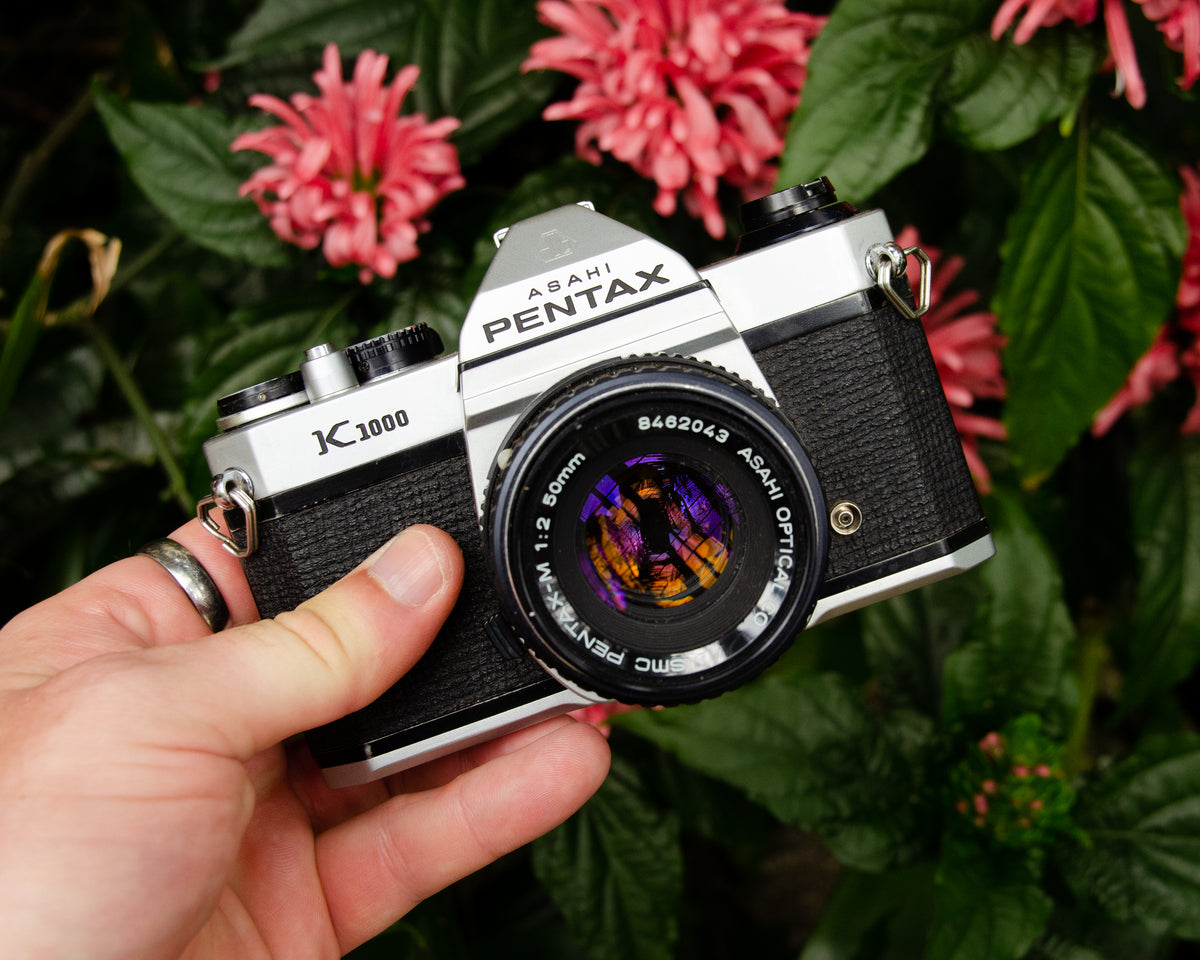
On a fully manual camera such as the Pentax K1000, the photographer adjusts the shutter speed and aperture while using the meter as a guide. Other cameras can take the reading a stage further by using it as part of an automatic exposure system, allowing the camera to select one of the exposure settings for you.
The important distinction is that the light meter measures and evaluates light; exactly what the camera then does with that information depends on the design of the camera.
What Does a Film Camera Light Meter Actually Measure?
A built-in camera meter usually measures reflected light: light that falls onto the subject, reflects from it and then travels towards the camera. That distinction matters because the camera does not know whether it is looking at a white wall, a black coat, a face or a landscape. It only knows how much light is being reflected towards its meter.
A pale subject can therefore reflect considerably more light than a dark subject even when both are standing in exactly the same lighting conditions. This is one reason photographers sometimes need to interpret or adjust the exposure suggested by the meter rather than treating every reading as an instruction.
Reflected Light vs Incident Light
There are two main ways photographers can meter light. Reflected-light meters measure the light bouncing back from the subject, which is how the majority of built-in film camera meters work. Incident-light meters measure the light actually falling onto the subject rather than the light reflected from it.
Incident meters are normally separate handheld devices, often recognisable by a white translucent dome. Because they measure the illumination reaching the subject rather than the subject's reflectivity, they can provide particularly consistent readings in situations where very light or very dark subjects might mislead a reflected-light meter.
For everyday film photography, however, a built-in reflected-light meter is far more convenient and, once you understand its limitations, is usually all that is required.
What Does TTL Metering Mean?
TTL stands for Through The Lens. With TTL metering, the camera measures light that has passed through the lens rather than relying on a separate external sensor that views the scene independently.
This is useful because the metering system is effectively evaluating the light travelling through the same optical path used to make the photograph. Changes to lenses, apertures and many filters can therefore be reflected in the meter reading.
TTL metering became extremely common on SLR film cameras and is one reason many cameras from the 1970s, 1980s and 1990s remain relatively straightforward to use today.
What Is Centre-Weighted Metering?
Some film cameras use centre-weighted metering. Rather than treating every part of the frame equally, the camera measures a wider area while giving greater importance to the central portion of the image. This suited traditional photographic compositions in which the main subject was frequently positioned around the centre of the frame.
The Nikon FG, for example, uses centre-weighted TTL metering and combines it with Program, Aperture Priority and Manual exposure modes. Reframing the same scene can therefore alter the meter reading if brighter or darker areas move into the portion of the frame receiving greater metering emphasis.

What Is a Selenium Light Meter?
Not every vintage camera light meter requires a battery. Some older cameras use a selenium light meter, in which a selenium cell generates a small electrical current when exposed to light. This made it possible to provide exposure metering without a separate battery and was widely used before battery-powered CdS and later electronic metering systems became commonplace.
The Olympus Trip 35 is one of the best-known examples of a camera using a selenium-based metering system. The obvious advantage is that the meter does not require a battery. The disadvantage is age: selenium cells can lose sensitivity over many decades, so a meter that still moves or reacts to changing light is not necessarily perfectly accurate.
With an older selenium-metered camera, it is sensible to compare its readings with a known-good meter before relying on it for an important roll of film.
How Do You Read a Film Camera Light Meter?
Different cameras present their readings in different ways, but most metering displays are designed to communicate the same basic information: whether the current combination of aperture and shutter speed is giving more light, less light or approximately the amount the meter considers appropriate.
Match-Needle Meters
Many classic manual SLR cameras use a moving needle in the viewfinder. As the photographer changes the aperture or shutter speed, the needle changes position. The aim is normally to bring it towards a reference point indicating a balanced exposure.
The Pentax K1000 is a familiar example. Its meter assists the photographer, but the aperture and shutter speed remain manually controlled. This makes the meter a teaching aid as much as an exposure tool because you can immediately see how changing either setting affects the reading.
LED Displays
Later cameras often replaced moving needles with electronic LEDs. Depending on the model, the viewfinder might show plus and minus indicators, arrows, coloured lights or another sequence showing whether the selected exposure is above, below or around the metered value.
The display looks different, but the principle remains similar: the camera is providing information that allows the photographer to adjust the exposure.
Automatic Exposure Displays
On automatic and semi-automatic cameras, the meter can become part of the camera's exposure-control system rather than simply advising the photographer. The Olympus OM10, for example, normally operates in aperture-priority automatic exposure. You select the aperture and the camera's metering system determines an appropriate shutter speed.
The shutter speed selected by the camera is indicated in the viewfinder, allowing you to see whether the resulting speed is practical for the photograph you are trying to take. You can then alter the aperture if you need a faster or slower shutter speed.
What Does ISO or ASA Have to Do with the Light Meter?
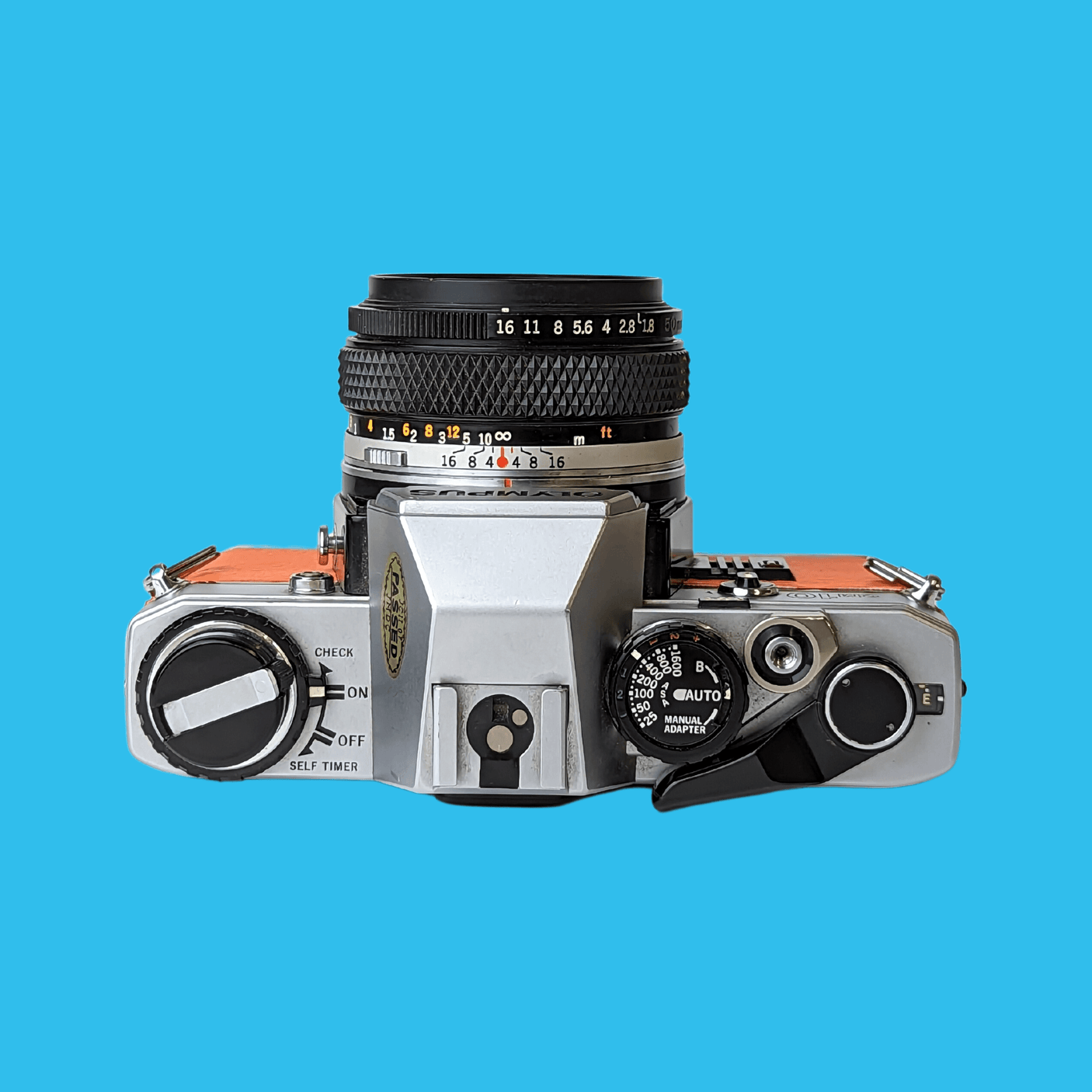
The meter needs to know the sensitivity of the film before it can calculate an appropriate exposure. On modern film packaging this is normally expressed as ISO. Older cameras may label the control ASA, but for normal photographic use the numerical value corresponds directly.
If you load ISO 400 film, for example, the camera should normally be set to 400. If it is accidentally left at ISO 100, the meter will calculate the exposure as though the film were four times less sensitive than it actually is. The result can be a substantial exposure error repeated across the entire roll.
If you are still learning how film speed, shutter speed and aperture work together, our guide to the exposure triangle explains the relationship in more detail.
Why Can a Light Meter Be Fooled?
Camera meters are extremely useful, but they cannot understand the subject in the way a photographer can. A reflected-light meter generally works on the assumption that the scene contains a reasonably average mixture of light and dark tones. In many everyday situations that produces a very usable exposure, but unusually bright or dark scenes can mislead it.
A snowy landscape, white wall or bright beach reflects a large amount of light. The meter may respond by recommending less exposure, which can make the scene appear darker than you intended. A predominantly dark scene can cause the opposite problem: the meter may recommend additional exposure and make the photograph brighter than the scene should appear.
Backlighting presents another common challenge. If a person is standing in front of a bright window or sky, the brighter background can influence the reading enough to leave the person's face underexposed. Understanding why this happens is more valuable than simply learning to follow the meter unquestioningly.
Does the Light Meter Choose the Exposure for You?
Not necessarily. On a manual camera such as the Pentax K1000, the meter provides guidance while the photographer chooses both aperture and shutter speed. On an aperture-priority camera, the photographer normally chooses the aperture and the camera selects a shutter speed. A shutter-priority system reverses those responsibilities, while Program exposure can allow the camera to determine both settings.

This is why having an electronic light meter does not automatically make a camera fully automatic. Metering technology and exposure mode are related, but they are not the same thing.
We explore that distinction further in our guide to mechanical vs electronic film cameras.
Are Old Film Camera Light Meters Still Accurate?
Many vintage light meters remain remarkably accurate, but age can affect their performance. A meter may still react to changes in brightness while no longer being perfectly calibrated, and there are several possible reasons for that.
Ageing electronic components, oxidised contacts, corrosion around a battery compartment, deterioration of a light-sensitive cell or the use of an unsuitable replacement battery can all affect readings. Some older cameras were also designed around mercury batteries that are no longer generally available, and replacement cells may have different electrical characteristics.
None of this means an old meter should automatically be distrusted. Plenty of vintage cameras continue to meter very well decades after manufacture. The sensible approach is to check how the individual camera behaves rather than assuming accuracy — or inaccuracy — purely because of its age.
How Can You Test an Old Film Camera Light Meter?
A straightforward comparison can give you a useful indication of whether an old meter is behaving sensibly. Install the correct fresh battery if the camera requires one, set the appropriate ISO and point the camera at an evenly lit scene. Note the suggested exposure and compare it with a trusted handheld meter, a digital camera or a reputable light-meter app set to the same ISO.
Repeat the comparison under brighter and darker conditions rather than relying on a single reading. Different cameras and metering patterns can produce small variations, so the readings do not have to be numerically identical. Large or inconsistent differences, however, can indicate that the meter or its power supply requires further investigation.
If you are considering a vintage camera, metering should be checked alongside shutter operation, film transport, lens condition, seals and the battery compartment. Our used film camera buying checklist covers these areas in more detail.
What If My Film Camera Light Meter Does Not Work?
A failed meter does not always mean the camera itself is unusable. Some mechanically operated cameras can continue taking photographs even when their meter has no power. The Pentax K1000 is a good example: its battery powers the meter, while the camera's fundamental mechanical operation does not depend on that meter battery.
In that situation, exposure can be determined using a handheld meter, a smartphone app or traditional exposure knowledge such as the Sunny 16 rule. Electronic cameras can be different because some models use battery power not only for metering but also for shutter timing and automatic exposure. On those cameras, an electrical or battery problem can affect normal camera operation as well as metering.
Can You Use a Phone as a Film Camera Light Meter?
Yes. A light-meter app can be a useful companion to an older film camera, particularly if the camera has no built-in meter or you want to check whether its existing meter is behaving sensibly. Modern smartphones can use their camera systems to estimate exposure and dedicated apps can convert that information into familiar combinations of ISO, shutter speed and aperture.
A phone is not necessarily a substitute for a dedicated professional incident meter in every situation, but for everyday film photography it can be a practical and inexpensive solution. It also provides a useful safety net for photographers who enjoy using mechanical cameras whose built-in meters have stopped working.
What Is the Sunny 16 Rule?
The Sunny 16 rule is a traditional method of estimating exposure without using a light meter. In bright direct sunlight, set the aperture to f/16 and choose a shutter speed close to the reciprocal of the film speed.
With ISO 100 film, for example, a shutter speed around 1/100 or 1/125 second at f/16 is a typical starting point. With ISO 400 film, a setting around 1/400 or 1/500 second at f/16 serves the same purpose. From there, the aperture or shutter speed can be adjusted as the light changes.
Sunny 16 is useful not only when you have no meter but also as a rough sense-check. If an old camera gives a reading in bright sunshine that is dramatically different from what you would reasonably expect, it may be worth investigating before committing an entire roll of film.
Do Beginners Need a Camera with a Working Light Meter?
No, but a working built-in meter can make learning considerably easier. It allows a new photographer to concentrate on composition, focusing and the relationship between shutter speed and aperture without having to estimate every exposure from scratch.
Manual cameras with built-in meters are particularly useful learning tools because the photographer still makes the exposure decisions while receiving immediate guidance from the camera. More automated cameras can make the process simpler again by selecting part or all of the exposure automatically.
If you are deciding which approach suits you, our beginner's guide to choosing your first film camera looks at the wider choice of camera types and features.
Film Camera Light Meter FAQs
Do all film cameras have light meters?
No. Many early cameras and some fully mechanical designs have no built-in light meter. Photographers can instead use a separate handheld meter, a smartphone metering app or traditional exposure methods such as Sunny 16.
Does a film camera light meter need a battery?
Many do, but not all. Electronic and CdS metering systems normally require electrical power, while some older selenium meters generate a small electrical current from the available light and therefore do not require a separate meter battery.
Can a film camera work if the light meter is broken?
Some can. A mechanically controlled camera may continue operating even if its built-in meter has failed. A camera that depends on electronics for shutter operation may require electrical power for both metering and normal operation.
Is a handheld light meter better than a built-in camera meter?
Not necessarily. Built-in meters are convenient and can be extremely accurate. A handheld incident meter has particular advantages in difficult lighting because it can measure the light falling onto the subject instead of relying on the amount of light the subject reflects.
Why does my film camera meter change when I recompose?
Different areas of a scene reflect different amounts of light. Reframing can change which bright or dark areas are influencing the meter, particularly with centre-weighted or other reflected-light metering systems.
Can I use a digital camera to check a film camera light meter?
Yes. Set both cameras to the same ISO and compare their suggested exposures under the same lighting conditions. Small differences can occur because cameras use different metering patterns, but the comparison is useful for identifying readings that are obviously inconsistent.
Final Thoughts: Learning to Trust — and Understand — Your Light Meter
A light meter is one of the most useful tools found in a film camera, but it becomes much more valuable once you understand what it is actually doing. It measures light; it does not know whether you are photographing snow, a dark building, a backlit portrait or a black cat on a sofa. Interpreting the scene still belongs to the photographer.
For beginners, a working built-in meter can make film photography considerably easier. As your experience grows, understanding when reflected-light meters can be misled gives you greater control over the exposure rather than making you dependent on the meter reading.
And if an older camera's meter no longer works, that does not necessarily mean the end of the camera. Depending on the model, a handheld meter, smartphone app or a working knowledge of exposure may be all you need to keep shooting.
If you are looking for your next camera, explore our 35mm SLR film cameras, or read our guide to checking a used film camera before you buy.
(FCS-B-098)