
A Beginner’s Guide to Understanding Vintage 35mm Camera Lenses
Choosing a film camera is only part of the story. On an interchangeable-lens camera, the lens you attach can have just as much influence on the photographs you make. Yet for someone getting started with film photography, the numbers and markings around a vintage lens can initially seem confusing.
What does 50mm mean? Why is one lens marked f/1.8 while another says f/4? Is a lower f-number better? And perhaps most importantly when buying vintage equipment, how do you know whether a lens will actually fit your film camera?
Fortunately, the basic principles are straightforward once you know what you are looking at. In this guide, we’ll explain focal length, aperture, prime and zoom lenses, and the different lens mounts found on popular 35mm film cameras. We’ll also look at some of the compatibility issues worth checking before buying a vintage lens.
What Do the Numbers on a Film Camera Lens Mean?
Pick up a typical 35mm camera lens and you will usually find several numbers printed or engraved around the front, barrel or aperture ring. Depending on the lens, these can tell you its focal length, maximum aperture, focusing distance and sometimes the diameter required for filters or a lens cap.
For example, a lens marked 50mm f/1.8 has a focal length of 50mm and a maximum aperture of f/1.8. A zoom marked 35–70mm f/4 can change focal length between 35mm and 70mm and has a maximum aperture of f/4.
Those two measurements — focal length and maximum aperture — are among the most useful things to understand when choosing a lens.
Understanding Focal Length
Focal length is an optical characteristic of a lens, expressed in millimetres. Together with the film format, it determines how wide or narrow the angle of view will appear in your photograph. Because we are concentrating on traditional 35mm film cameras here, we can compare focal lengths on the same familiar format.
A shorter focal length gives you a wider field of view, allowing more of the scene into the frame. A longer focal length gives you a narrower field of view and makes it easier to fill the frame with a more distant subject.
On a 35mm film camera, a 50mm lens is traditionally regarded as a standard or normal lens. It provides a natural-looking field of view and is extremely versatile, which is one reason 50mm lenses were supplied with so many classic SLR cameras.
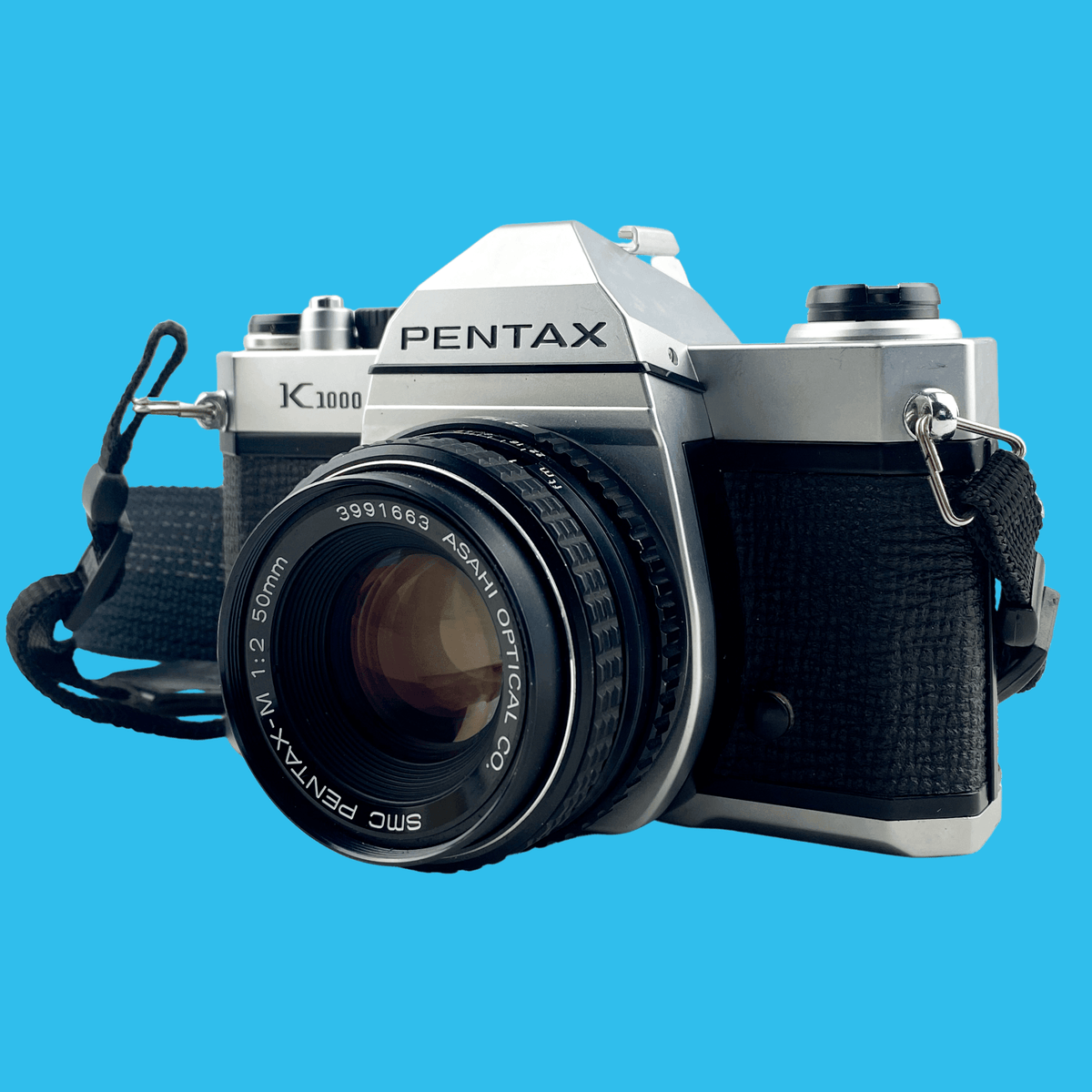
Move down to around 28mm or 35mm and the view becomes wider. These focal lengths can be useful for landscapes, street photography, travel, architecture and situations where you want to include more of the surroundings.
Move in the other direction to 85mm, 100mm or 135mm and the field of view becomes narrower. These longer lenses can be useful for portraits, details and subjects that are difficult to approach closely.
It is also worth clearing up a common misconception. A longer lens is often said to “compress perspective”, but perspective itself is determined by the position of the camera relative to the subject. Changing focal length often encourages the photographer to move backwards or forwards to maintain similar framing, and it is that change in shooting position that alters the perspective.
Aperture and the Numbers on the Lens
The other number you will encounter constantly is the aperture, expressed as an f-number such as f/1.4, f/1.8, f/2.8, f/4, f/5.6 or f/8.
Inside the lens is an adjustable opening called the aperture. Making that opening wider allows more light to reach the film; making it smaller allows less light through. Aperture therefore forms one part of the exposure relationship between aperture, shutter speed and film ISO. If you're still getting familiar with the shutter-speed numbers on a film camera, see our guide to film camera shutter speeds.
The numbering can seem backwards at first. A smaller f-number means a wider aperture, so f/1.8 is wider than f/4. Conversely, a larger f-number such as f/11 or f/16 represents a smaller opening.
Aperture also affects depth of field — the range of distance that appears acceptably sharp. Wider apertures can produce a shallower depth of field, helping to separate a sharply focused subject from its background. Smaller apertures generally increase the depth of field, although focusing distance and focal length also influence the result.
If a lens is described as a 50mm f/1.8, the f/1.8 figure normally tells you its maximum available aperture. You are not restricted to shooting at f/1.8; the lens can be stopped down to smaller apertures when required.
A lens with a very wide maximum aperture can be useful in lower light and can provide greater control over shallow depth of field, but that does not automatically make it the “better” lens. Size, weight, optical design, condition, price and the kind of photography you want to do are all relevant.
Prime Lenses and Zoom Lenses
A prime lens has one fixed focal length. A 50mm prime is always 50mm, so changing the framing substantially usually means moving yourself or changing your shooting position.
A zoom lens covers a range of focal lengths. A 35–70mm zoom, for example, lets you move from a moderately wide view through the standard range and towards a short telephoto view without changing lenses.
Neither type is automatically superior. Vintage prime lenses are often compact and can offer wide maximum apertures, while a zoom provides flexibility when you cannot easily change position or do not want to carry several lenses.
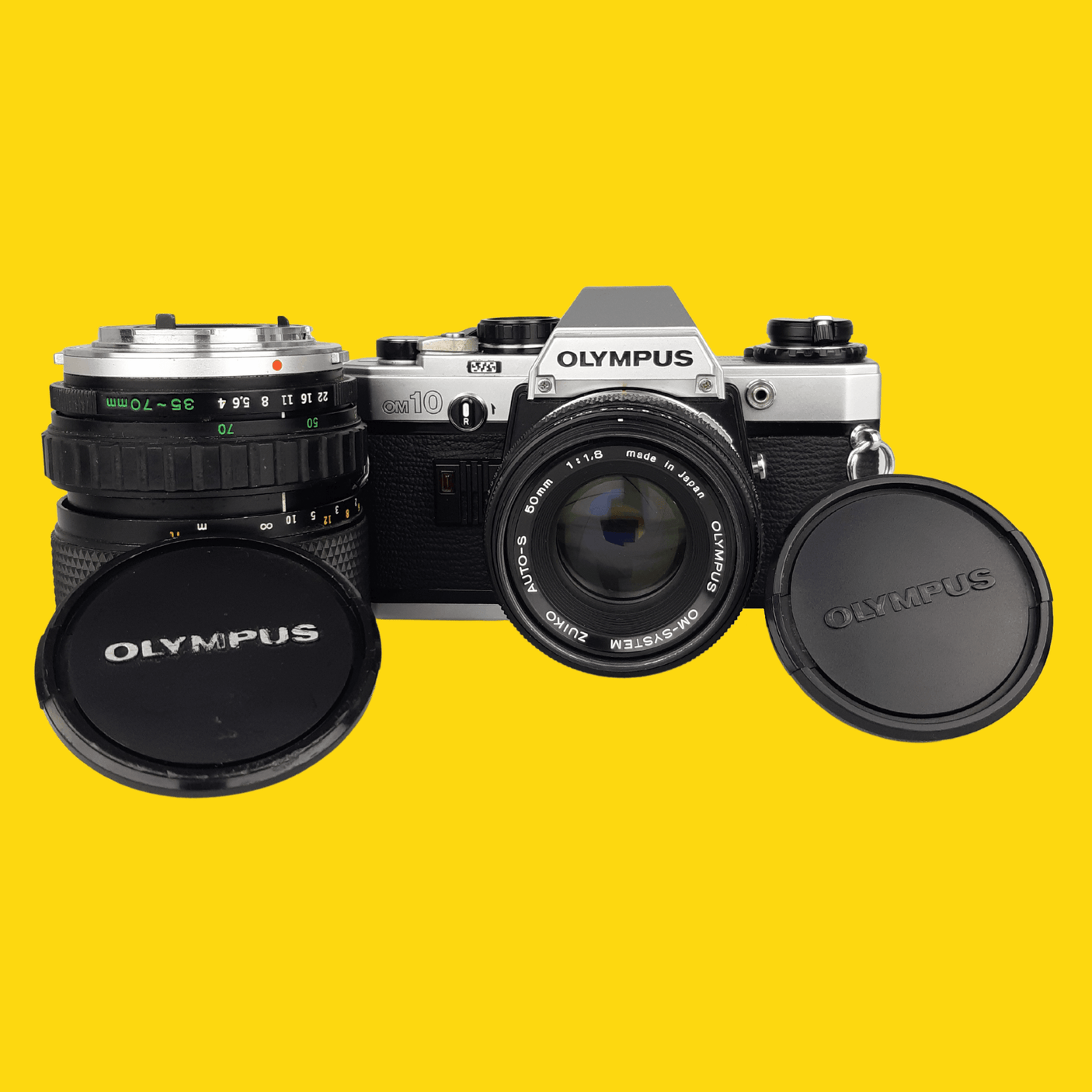
A useful real-world example is the Olympus OM10 with 50mm f/1.8 and 35–70mm f/4 lenses. The 50mm gives you a classic standard prime, while the 35–70mm zoom provides a range of focal lengths in a single lens.
If you want to explore the differences in more detail, see our guide to prime vs zoom lenses.
Understanding Film Camera Lens Mounts
Focal length and aperture tell you what a lens can do photographically. The lens mount determines whether you can actually attach it to your camera.
The mount is the physical connection between the lens and camera body. Depending on the camera system and period, it can also provide mechanical or electrical connections that allow the camera and lens to communicate aperture or exposure information.
This is particularly important when buying vintage equipment because there is no universal film-camera lens mount. A 50mm lens may look broadly similar to another 50mm lens while using a completely different mounting system.
It is therefore not enough to choose a lens simply because it is the right brand or because its focal length suits you. You need to establish that its mount — and where relevant its particular generation or specification — is compatible with the camera body you intend to use.
Pentax K, Nikon F, Olympus OM and Canon FD
Some of the most popular vintage 35mm SLR systems provide good examples of why the mount matters.
The Pentax K1000, for example, uses the Pentax K mount. Pentax introduced the bayonet K mount in the 1970s, replacing the screw-mount system used by earlier Pentax SLRs such as the Spotmatic series. This means that seeing the Pentax name on both a camera and an older lens does not by itself prove that they attach directly to one another.
The Nikon FG belongs to Nikon’s long-running F-mount family. Nikon retained the basic F mount over many generations, which gave the system an unusually long history, but that longevity can also make compatibility more complicated. Different generations of Nikon lenses and camera bodies can support different metering, aperture and exposure functions.
The Olympus OM10 is part of the Olympus OM system and uses the OM lens mount. Classic OM-system lenses include compact standard primes as well as wide-angle, telephoto and zoom options.
Canon provides another particularly useful example. The Canon AE-1 uses Canon’s FD mount. Canon later introduced its EF mount for a new generation of autofocus cameras, so a later Canon EF lens should not be assumed to be directly compatible with an FD-mount AE-1 simply because both carry the Canon name.

The lesson is simple: identify the camera’s lens mount before buying a lens. Brand name alone is not enough.
Does the Same Lens Mount Always Mean Full Compatibility?
Not necessarily. This is where vintage lens compatibility becomes slightly more complicated than simply checking whether two items share the same mount name.
Camera systems evolved. Manufacturers introduced new aperture couplings, metering systems, electronic contacts and automatic exposure functions while sometimes retaining all or part of an existing mount. As a result, a lens may physically attach to a camera but not necessarily provide every function that another lens from the same broad system would offer.
Nikon’s long-lived F-mount system is a good example because different generations of Nikon bodies and lenses have different compatibility requirements. Similar considerations can arise elsewhere when mixing equipment from different periods.
For someone buying a first film camera, the safest approach is not to assume. Check the exact camera model and exact lens before purchasing, particularly if the lens and body were produced many years apart.
Can You Use a Lens Adapter on a Film Camera?
Adapters can sometimes allow a lens from one system to be fitted to a camera using another mount, but they are not a universal solution.
Whether an adapter works properly depends on the two mounts involved and the design of the adapter. Some combinations may lose automatic aperture operation or metering functions. Others may affect the ability to focus all the way to infinity, while certain conversions require additional optical elements.
Adapters can be useful for photographers who understand the limitations and have a particular lens they want to use. For a beginner assembling a first 35mm system, however, choosing a lens designed to work natively with the camera is normally much simpler.
Choosing Your First Film Camera Lens
If you are buying your first interchangeable-lens 35mm camera, you do not necessarily need a collection of lenses immediately. A standard prime is one of the simplest places to start.
A 50mm lens is popular because it is versatile enough for everyday photography, portraits, travel, details and general learning. Many classic cameras were originally paired with lenses around this focal length, including examples of the Olympus OM10 and Pentax K1000 available through Film Camera Store.
Once you have spent some time shooting, your photographs will usually tell you what you need next. If you regularly find yourself wanting to include more of the scene, a wider lens may be useful. If you often want tighter framing of distant subjects, you may prefer a longer focal length. If flexibility is more important than having a single compact prime, a zoom may make more sense.
The important point is to choose according to the photographs you actually want to make rather than assuming that more lenses automatically mean better photography.
What to Check When Buying a Used Film Camera Lens
Compatibility is only one part of buying a vintage lens. Condition matters too.
Inspect the glass for obvious fungus, haze, separation or significant scratches. A few tiny dust particles inside an older lens are not unusual and may have little practical effect, but substantial haze or fungal growth deserves much more caution.
Turn the focusing ring through its full range. It should move predictably without excessive stiffness, grinding or looseness. If the lens has a manual aperture ring, operate it through the available settings and check that it moves correctly.
Where the aperture blades are visible, they should respond properly and should not appear obviously contaminated with oil. Also inspect the lens mount, filter thread and barrel for impact damage or signs that the lens has been dropped.
Cosmetic wear by itself does not necessarily make a vintage lens poor. A lens can show decades of external use and still perform very well. Mechanical and optical condition are much more important than expecting old photographic equipment to look completely new.
If you are buying a camera and lens together, our film camera buying checklist covers some of the other areas worth checking before choosing vintage equipment.
Film Camera Lens FAQs
What does 50mm mean on a film camera lens?
50mm is the focal length of the lens. On a 35mm film camera, 50mm is traditionally considered a standard focal length and provides a versatile, natural-looking field of view for many types of photography.
Is f/1.8 better than f/4?
Not automatically. An f/1.8 lens can open wider than an f/4 lens, allowing more light through and potentially producing a shallower depth of field. Whether that makes it the better choice depends on the lens, the subject and how you intend to use it.
Will any vintage lens fit any film camera?
No. Interchangeable-lens cameras use specific lens mounts, and different manufacturers — and sometimes different generations from the same manufacturer — use different systems. Always check the exact camera and lens compatibility before buying.
Can I use a modern lens on an old film camera?
Sometimes, but it depends entirely on the camera, lens mount and lens generation. A lens may physically fit but still lose some functions, while others will not mount at all. Compatibility should be checked for the specific combination rather than assumed from the brand name.
Is a 50mm lens good for beginners?
Yes. A 50mm prime is an excellent starting point on a 35mm film camera because it is relatively simple, versatile and useful across many everyday subjects. It also encourages you to learn composition by changing your position rather than relying entirely on a zoom.
Should I buy a prime lens or a zoom lens?
That depends on how you photograph. A prime provides one fixed focal length and is often compact, while a zoom lets you change focal length without changing lenses. Neither is inherently better; they simply encourage different ways of working.
Final Thoughts
Film camera lenses become much easier to understand once you separate the information into three questions: what focal length is it, how wide can its aperture open, and will it work correctly with my camera?
Focal length determines the field of view on your 35mm camera. Aperture controls how much light passes through the lens and contributes to depth of field. The lens mount determines whether the lens and camera can work together in the first place.
You do not need an extensive lens collection to enjoy film photography. A well-chosen 50mm prime can be enough to learn with for years, while a wider lens, telephoto or zoom can be added later when your photography gives you a reason to need one.
If you are choosing your first setup, explore our 35mm SLR film cameras or read our beginner’s guide to choosing your first film camera.
(FCS-B-100)